
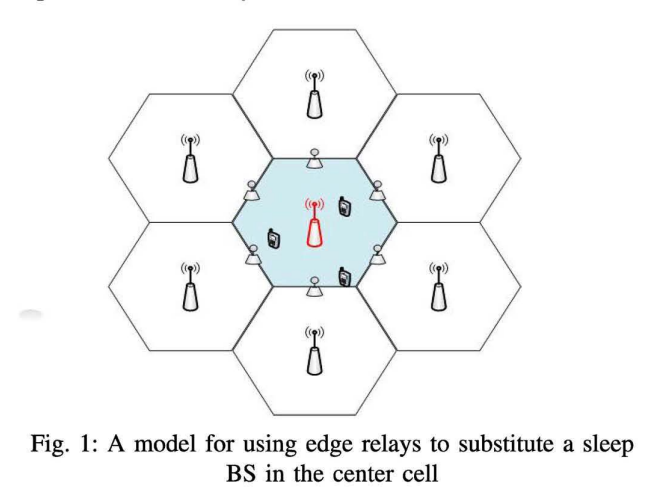
Joint relay assignment and adaptive modulation for energy-efficient cellular networks
Energy efficient operation of cellular systems becomes a core design goal for economic and environment-friendly network operation. Several studies have shown that the energy consumed in base stations represents 60-80% of the energy consumption in cellular networks. In this paper, we develop an optimization framework that exploits several energy efficient techniques including switching power modes of base stations, Adaptive Modulation (AM), and the use of relays. Our main objective is to reduce both, transmitted and circuit power, subject to satisfying the quality of service constraints. To
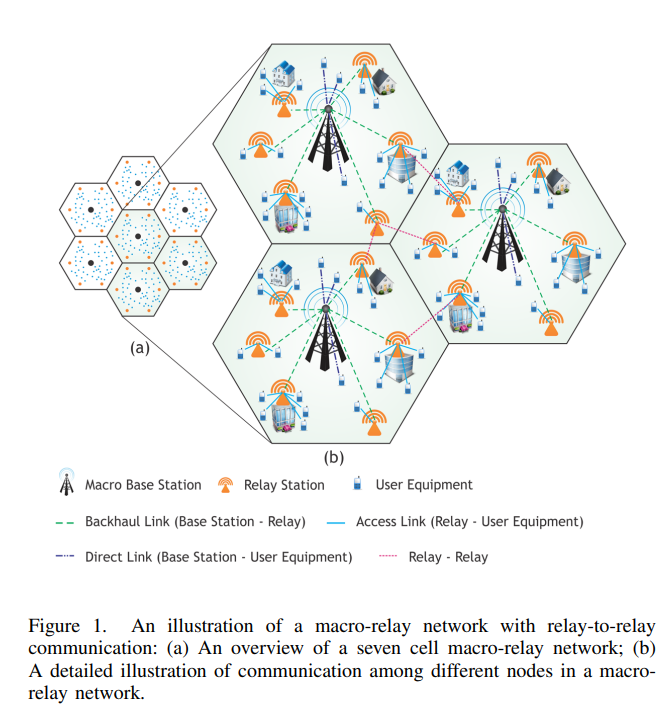
Towards energy efficient relay placement and load balancing in future wireless networks
This paper presents an energy efficient relay deployment algorithm that determines the optimal location and number of relays for future wireless networks, including Long Term Evolution (LTE)-Advanced heterogeneous networks. We formulate an energy minimization problem for macro-relay heterogeneous networks as a Mixed Integer Linear Programming (MILP) problem. The proposed algorithm not only optimally connects users to either relays or eNodeBs (eNBs), but also allows eNBs to switch into inactive mode. This is possible by enabling relay-to-relay communication which forms the basis for relays to
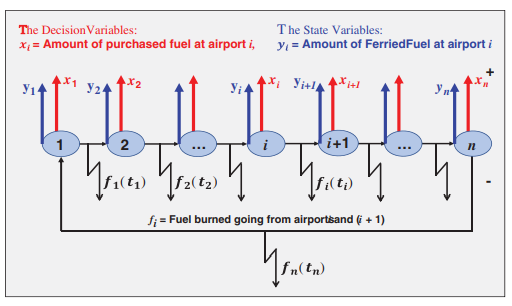
A stochastic flight problem simulation to minimize cost of refuelling
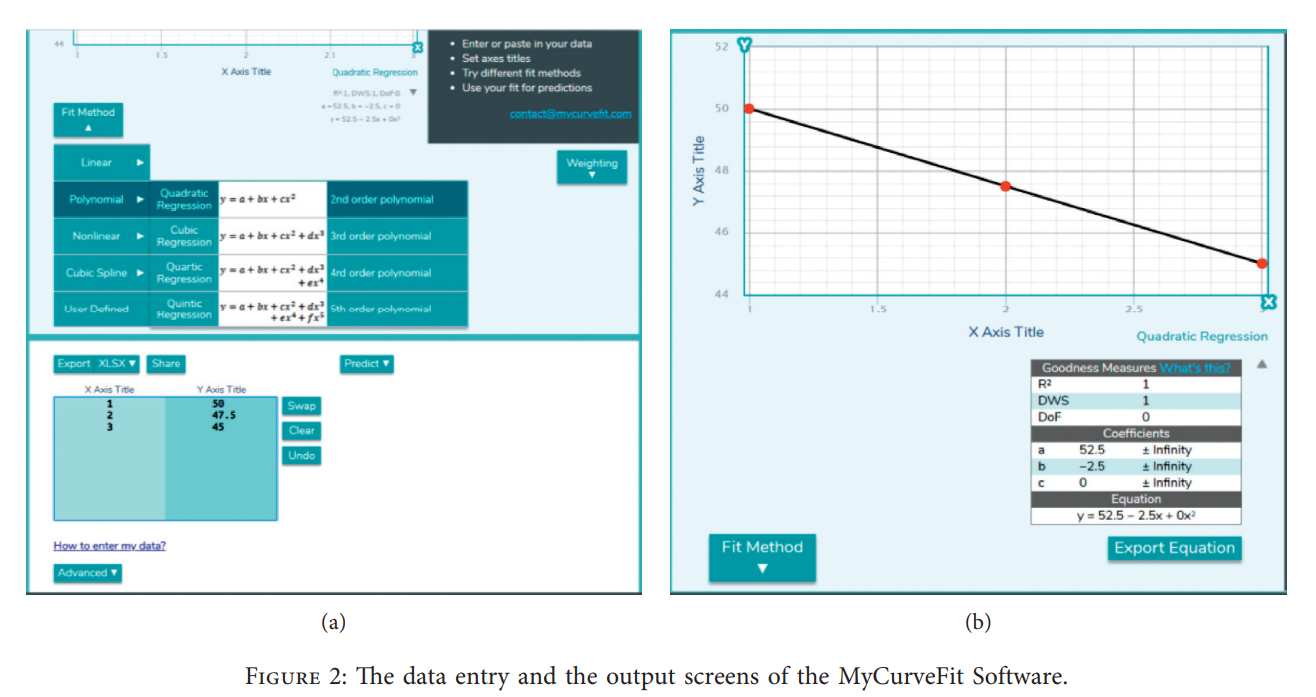
Commercial airline companies are continuously seeking to implement strategies for minimizing costs of fuel for their flight routes as acquiring jet fuel represents a significant part of operating and managing expenses for airline activities. A nonlinear mixed binary mathematical programming model for the airline fuel task is presented to minimize the total cost of refueling in an entire flight route problem. The model is enhanced to include possible discounts in fuel prices, which are performed by adding dummy variables and some restrictive constraints, or by fitting a suitable distribution
Optimum Scheduling the Electric Distribution Substations with a Case Study: An Integer Gaining-Sharing Knowledge-Based Metaheuristic Algorithm
This work is dedicated to the economic scheduling of the required electric stations in the upcoming 10-year long-term plan. The calculation of the required electric stations is carried out by estimating the yearly consumption of electricity over a long-time plan and then determining the required number of stations. The aim is to minimize the total establishing and operating costs of the stations based on a mathematical programming model with nonlinear objective function and integer decision variables. The introduced model is applied for a real practical case study to conclude the number of
Maximum throughput of a cooperative energy harvesting cognitive radio user
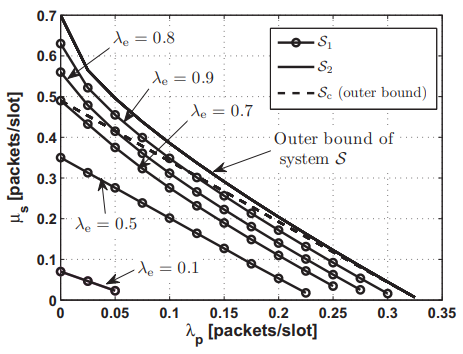
In this paper, we investigate the maximum throughput of a saturated rechargeable secondary user (SU) sharing the spectrum with a primary user (PU). The SU harvests energy packets (tokens) from the environment with a certain harvesting rate. All transmitters are assumed to have data buffers. In addition to its own traffic buffer, the SU has a buffer for storing the admitted primary packets for relaying; and a buffer for storing the energy tokens harvested from the environment. We propose a new cooperative cognitive relaying protocol that allows the SU to relay a fraction of the undelivered
Hierarchical proactive caching for vehicular ad hoc networks
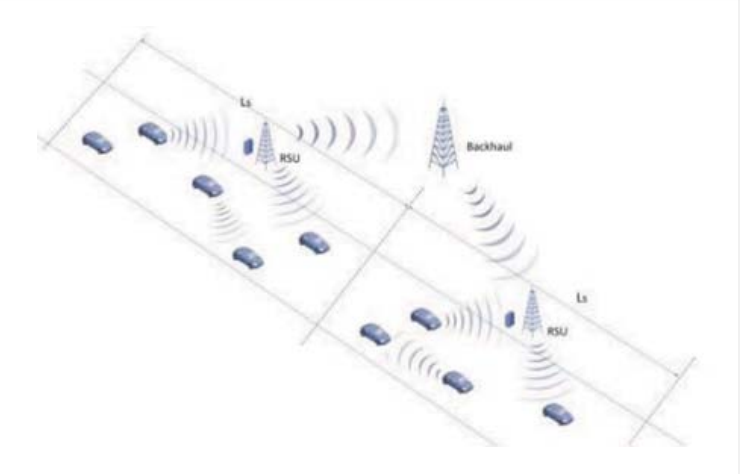
Recently, emerging vehicular applications are increasing the demand of vehicles which form significant burdens on network backhaul and represents a cause to the quality of experience (QoE) decay of the vehicular users. Proactive caching is a promising technique to mitigate the load on core networks by caching some of the expected data items. This work proposes a hierarchical proactive caching scheme which jointly considers caching in vehicles and roadside units (RSUs). Minimization of the vehicle communication latency is the main objective of our study. The optimization problem is formulated
Towards evolving sensor actor networks
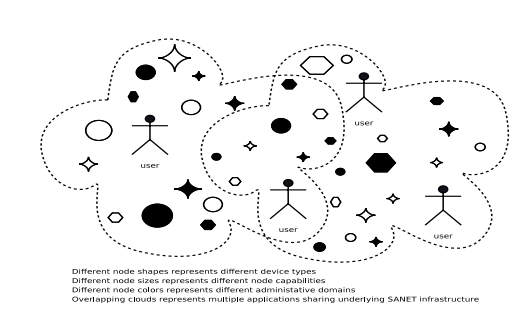
Sensor Actor NETworks (SANET) represent a major component of ubiquitous service environments promising interesting solutions to a wide range of problems. Despite the obvious increase in the research activities proposing architectures and protocols for SANETs, we are still no where near the production of industrial-grade SANET software that can be relied upon for mission critical applications. The cost of programming, deploying and maintaining SANET environments is still highly prohibitive due to the lack of industrial tools capable of realizing adaptive SANET software in a cost effective way

Analytical Markov model for slotted ALOHA with opportunistic RF energy harvesting
In this paper, we investigate the performance of an ALOHA random access wireless network consisting of nodes with and without RF energy harvesting capability. We develop and analyze a Markov model for the system when nodes with RF energy harvesting capability are infinitely backlogged. Our results indicate that the network throughput is improved when the conventional nodes are underloaded. On the contrary, when all types of nodes have finite backlogs, we numerically demonstrate that the network throughput and delay are improved when the overall system is overloaded. We show that there exists a
Simulation of Water Wave Interaction with Large Submerged Square Obstacles
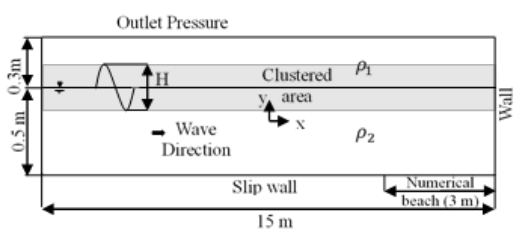
Water waves propagation over submerged obstacles is considered. The problem serves as an efficient model for modeling breakwaters. A numerical wave tank is developed to simulate the induced flow field. The model is based on multiphase viscous flow assumptions. Computations are performed adopting clustered grids and suitable initial and boundary conditions. The results are verified using the flow field particle image velocimetry (PIV) measurements. Spatial and temporal resolutions are validated. Complex flow phenomena occurring due to the presence of the relatively large sized obstacle are
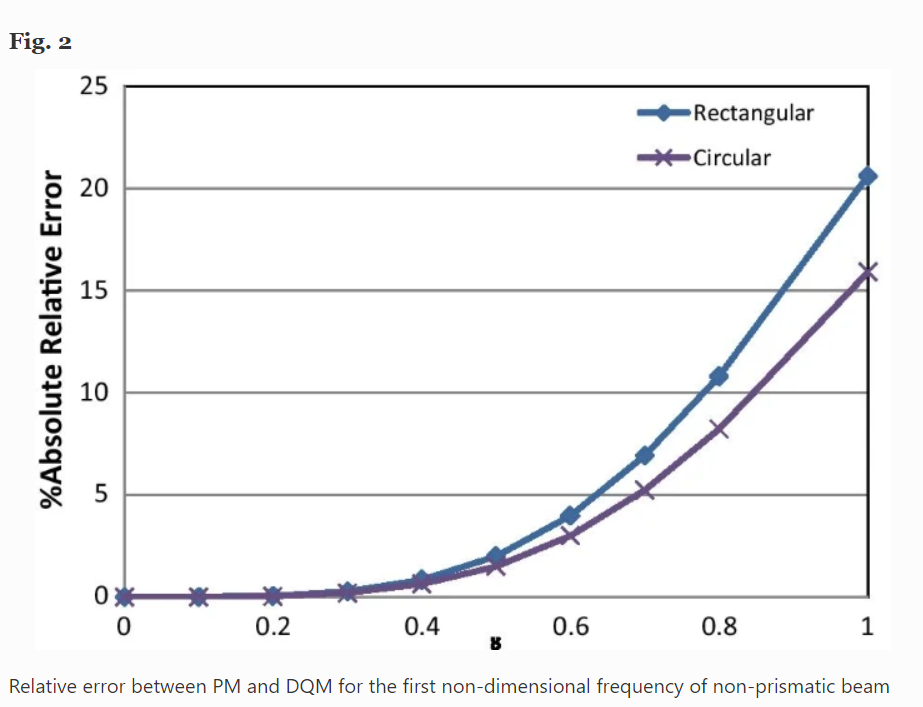
Analytic and numeric analysis for deformation of non-prismatic beams resting on elastic foundations
Background: The buckling load as well as the natural frequency under axial load for non-prismatic beam is a changeling problem. Determination of buckling load, natural frequency, and elastic deflection is very important in civil applications. The current paper used both perturbation method (PM), analytic method, and differential quadrature method (DQM), numerical method, to find buckling load and natural frequency with different end supports. The deflection of the beam resting on an elastic foundation under transverse distributed and axial loads is also obtained. Both PM and DQM are used for