
Proactive resource allocation in cognitive networks
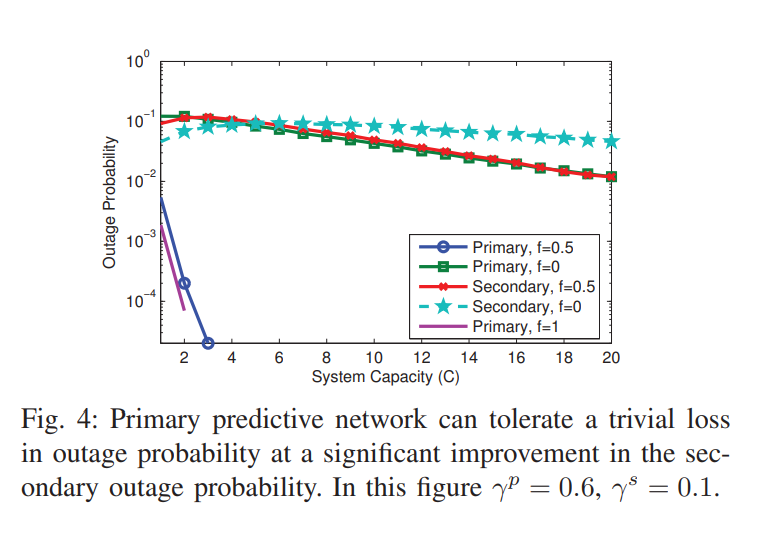
Recently we have introduced the notion of proactive resource allocation and predictive wireless networks, where intelligent wireless networks are capable of tracking and exploiting the repetition patterns in human behavior while accessing the network resources. This predictability advantage grants the network more flexibility to schedule users' requests over a longer time horizon, and thereby significantly improves the quality of service (QoS) defined as outage probability. In this paper we extend our analysis to consider a network of two different QoS classes. The first is a primary class

Practical provably secure communication for half-duplex radios
In this paper, we present a practical and provably secure two-way wireless communication scheme in the presence of a passive eavesdropper. The scheme implements a randomized scheduling and power allocation mechanism, where each legitimate node transmits in random time slots and with random transmit power. Such randomization results in ambiguity at the eavesdropper with regard to the origin of each transmitted frame. The scheme is analyzed in a time-varying binary block erasure channel model and secrecy outage probabilities are derived and empirically evaluated. The scheme is implemented over
Cooperative sensing with sequential ordered transmissions to secondary fusion center
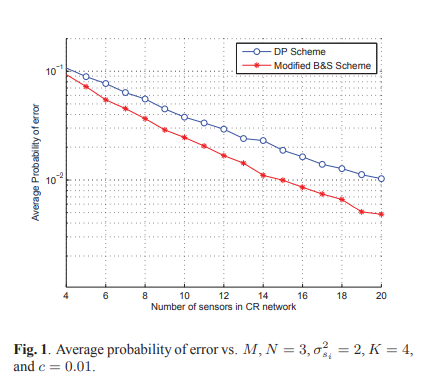
Successful spectrum sharing in a cognitive radio network depends on the correct and quick detection of primary activity. Cooperative spectrum sensing is therefore suggested to enhance the reliability of such detection. However, it renders another significant problem of increased detection delay and traffic burden. Moreover, efficient schemes for multi-sensor data fusion should be designed. In this paper, we employ sequential detection scheme together with ordered transmissions from cognitive detectors. We derive two sequential schemes, one that is capable of achieving the minimum probability
On the deterministic multicast capacity of bidirectional relay networks
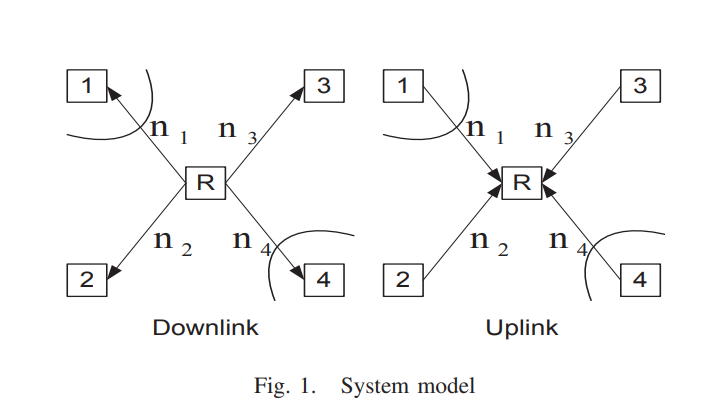
In this paper, we completely characterize the deterministic multicast capacity region of the symmetric two-pair bidirectional half duplex relay network with private messages. Towards this end, we first develop a new upper bound on the deterministic capacity region, based on the notion of a one-sided genie. We then proceed to construct novel detour schemes that achieve the upper bound by routing the bits intended for a certain receiver through the network rather than sending it directly. To the best of the authors' knowledge, this scenario corresponds to one of the rare cases where coding
Proactive resource allocation: Turning predictable behavior into spectral gain
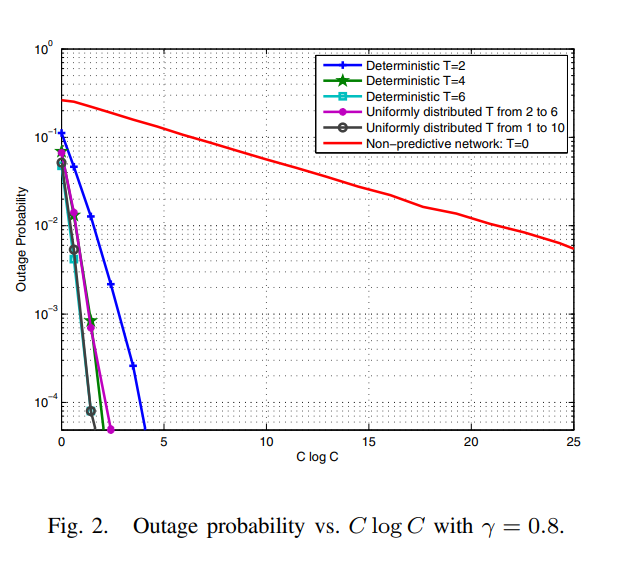
This paper introduces the novel concept of proactive resource allocation in which the predictability of user behavior is exploited to balance the wireless traffic over time, and hence, significantly reduce the bandwidth required to achieve a given blocking/outage probability. We start with a simple model in which the smart wireless devices are assumed to predict the arrival of new requests and submit them to the network T time slots in advance. Using tools from large deviation theory, we quantify the resulting prediction diversity gain to establish that the decay rate of the outage event
Propagation modeling for accurate indoor WLAN RSS-based localization
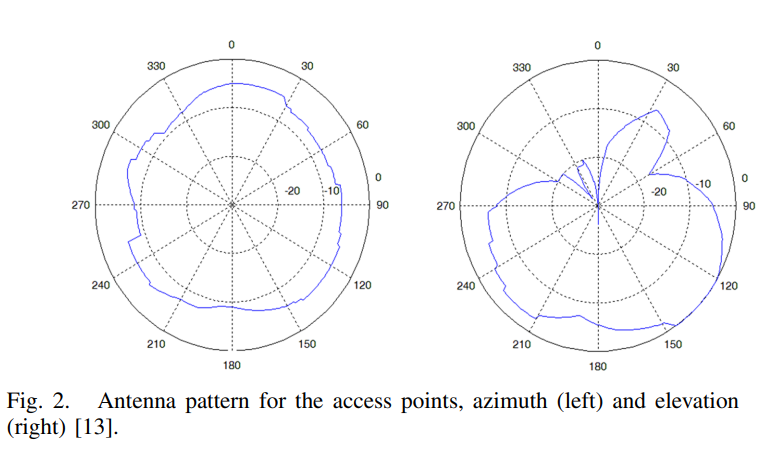
WLAN RSS-based localization has been a hot research topic for the last years. To obtain high accuracy in the noisy wireless channel, WLAN location determination systems usually use a calibration phase, where a radio map, capturing the signal strength signatures at different locations in the area of interest, is built. The radio map construction process takes a lot of time and effort, reducing the value of WLAN localization systems. In this paper, we propose 3D ray tracing as a way for automatically generating a highly accurate radiomap. We compare this method to previously used propagation
Time-based demand-constrained cross-layer resource allocation for wireless networks
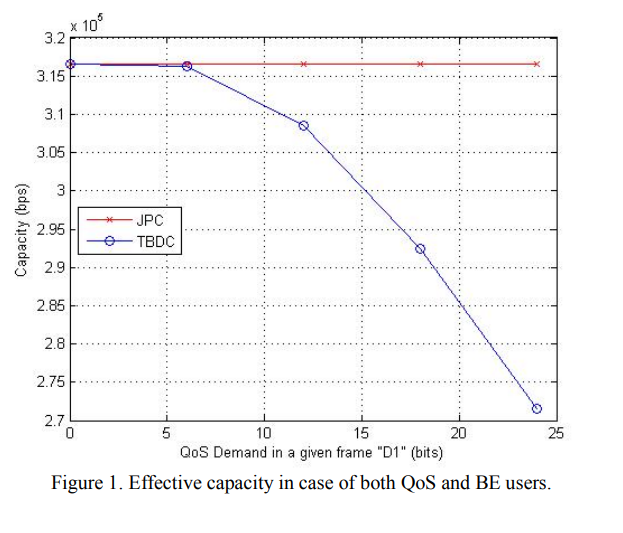
Efficient resource allocation is a critical component in multi-user QoS communications and high speed networks. In this paper, we devise a new mathematical model for the resource allocation problem that takes into account the users' demands in a PHY-MAC cross-layer approach. Incorporating the time axis in our model, the target is to maximize the number of bits transmitted in a given frame rather than maximizing the channel capacity or the average throughput. Our design is governed by constraints on users' demands (expressed in bits), energy expenditure, and frame duration. We model the
Opportunistic interference alignment for multiuser cognitive radio
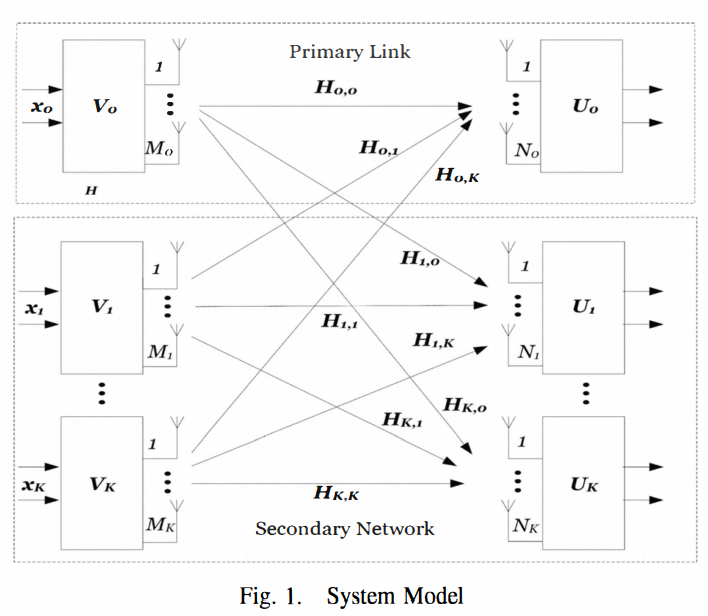
We present an interference alignment (IA) technique that allows multiple opportunistic transmitters (secondary users) to use the same frequency band of a pre-existing primary link without generating any interference. The primary and secondary transmit-receive pairs are equipped with multiple antennas. We exploit the fact that under power constraints on the primary transmitter, the rate of the primary user is maximized by water-filling on the singular values of its channel matrix leaving some eigen modes unused. The secondary users can align their transmitted signals to produce a number of
Analysis of a device-free passive tracking system in typical wireless environments
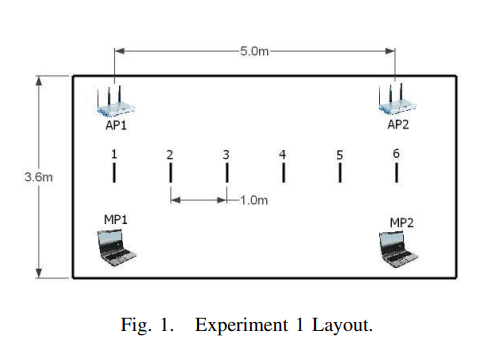
Device-free Passive (DfP) localization is a new concept in location determination where the tracked entity does not carry any device nor participate actively in the localization process. A DfP system operates by processing the received physical signal of a wireless transmitter at one or more monitoring points. The previously introduced DfP system was shown to enable the tracking of a single intruder with high accuracy in a highly controlled WLAN environment. In this paper, we propose and analyze different algorithms for DfP tracking in a typical indoor WLAN environment, rich in multipath. We
Distributed flooding-based storage algorithms for large-scale wireless sensor networks
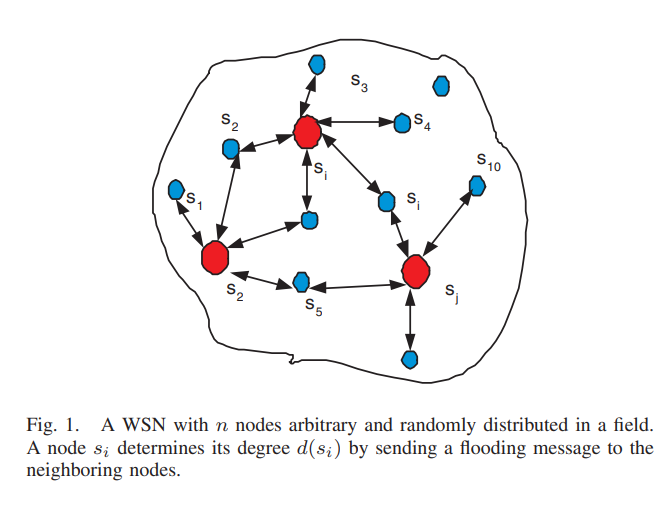
In this paper we propose distributed storage algorithms for large-scale wireless sensor networks. Assume a wireless sensor network with n nodes that have limited power, memory, and bandwidth. Each node is capable of both sensing and storing data. Such sensor nodes might disappear from the network due to failures or battery depletion. Hence it is desired to design efficient schemes to collect data from these n nodes. We propose two distributed storage algorithms (DSA's) that utilize network flooding to solve this problem. In the first algorithm, DSA-I, we assume that the total number of sensors