
A Review of Machine learning Use-Cases in Telecommunication Industry in the 5G Era
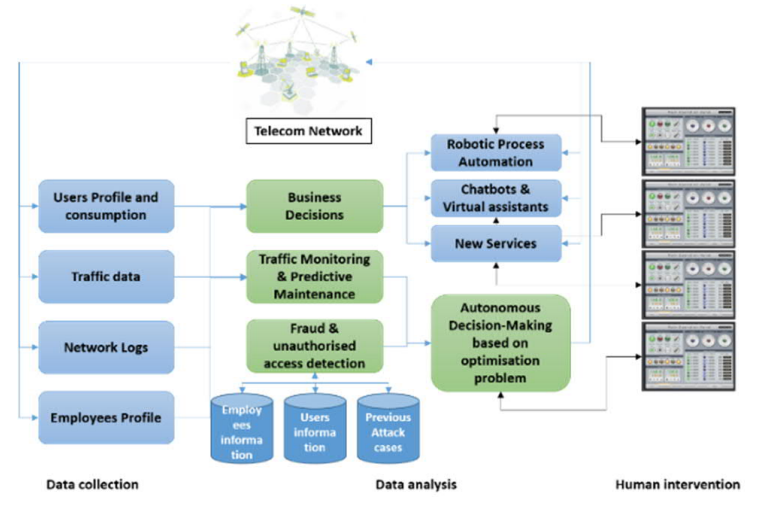
With the development of the 5G and Internet of things (IoT) applications, which lead to an enormous amount of data, the need for efficient data-driven algorithms has become crucial. Security concerns are therefore expected to be raised using state-of-the-art information technology (IT) as data may be vulnerable to remote attacks. As a result, this paper provides a high-level overview of machine-learning use-cases for data-driven, maintaining security, or easing telecommunications operating processes. It emphasizes the importance of analyzing the role of machine learning in the
Real-Time Lane Instance Segmentation Using SegNet and Image Processing
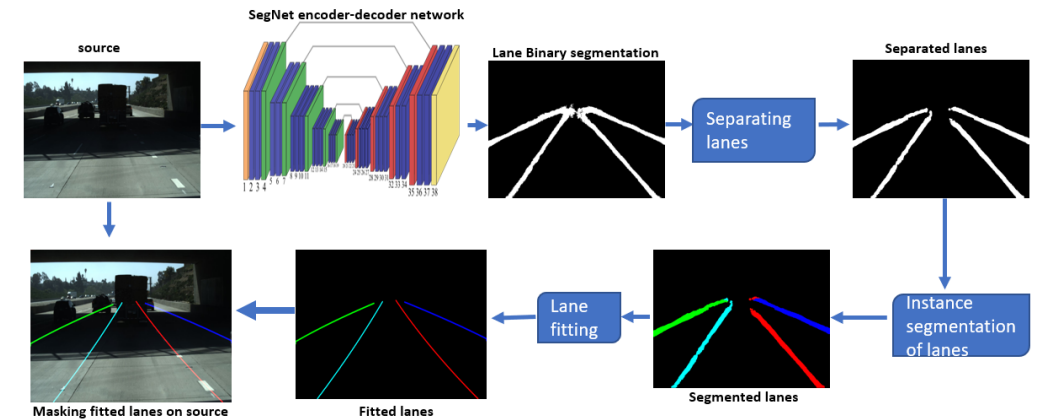
The rising interest in assistive and autonomous driving systems throughout the past decade has led to an active research community in perception and scene interpretation problems like lane detection. Traditional lane detection methods rely on specialized, hand-tailored features which is slow and prone to scalability. Recent methods that rely on deep learning and trained on pixel-wise lane segmentation have achieved better results and are able to generalize to a broad range of road and weather conditions. However, practical algorithms must be computationally inexpensive due to limited resources

Real-Time Collision Warning System Based on Computer Vision Using Mono Camera
This paper aims to help self-driving cars and autonomous vehicles systems to merge with the road environment safely and ensure the reliability of these systems in real life. Crash avoidance is a complex system that depends on many parameters. The forward-collision warning system is simplified into four main objectives: detecting cars, depth estimation, assigning cars into lanes (lane assign) and tracking technique. The presented work targets the software approach by using YOLO (You Only Look Once), which is a deep learning object detector network to detect cars with an accuracy of up to 93%
Comparative Analysis of Various Machine Learning Techniques for Epileptic Seizures Detection and Prediction Using EEG Data
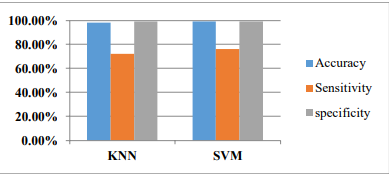
Epileptic seizures occur as a result of functional brain dysfunction and can affect the health of the patient. Prediction of epileptic seizures before the onset is beneficial for the prevention of seizures through medication. Electroencephalograms (EEG) signals are used to predict epileptic seizures using machine learning techniques and feature extractions. Nevertheless, the pre-processing of EEG signals for noise removal and extraction of features are two significant problems that have an adverse effect on both anticipation time and true positive prediction performance. Considering this, the
Self-Driving Car Lane-keeping Assist using PID and Pure Pursuit Control
Detection of lane boundaries is the primary role for monitoring an autonomous car's trajectory. Three lane identification methodologies are explored in this paper with experimental illustration: Edge detection, Hough transformation, and Birds eye view. The next step after obtaining the boundary points is to add a regulation rule to effectively trigger the regulation of steering and velocity to the motors. A comparative analysis is made between different steering controllers like PID or by using PID with a pure pursuit controller for the Lane Keeping Assist (LKA) system. A camera that sends
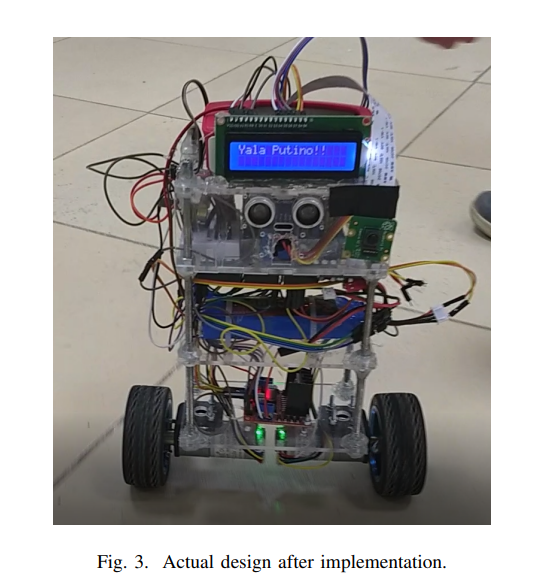
Hybrid Self-Balancing and object Tracking Robot Using Artificial Intelligence and Machine Vision
Over the past decade, mobile autonomous robots have been widely used efficiently for different applications. Recently, self-balancing robots attracted more attention and showed impressive performance. A self-balancing robot is simply a two-wheeled robot; hence it needs to be balanced vertically using a closed-loop control algorithm. In this paper, a new hybrid two-wheeled self-balancing robot is fully designed and implemented, which is able to track objects and to avoid obstacles efficiently. The proposed robot consists of a two-wheeled chassis equipped with an ultrasonic sensor, camera
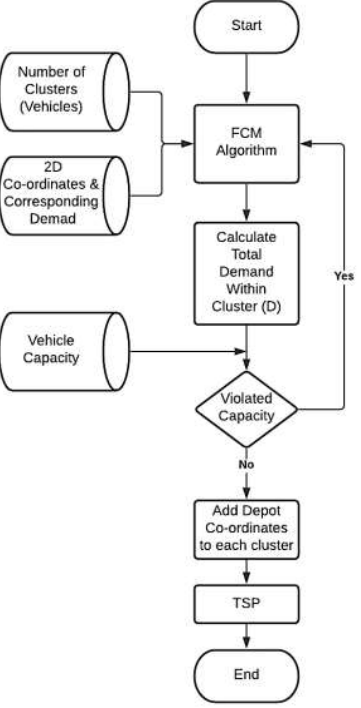
Modified fuzzy c-means clustering approach to solve the capacitated vehicle routing problem
Fuzzy C-Means clustering is among the most successful clustering techniques available in the literature. The capacitated vehicle routing problem (CVRP) is one of the most studied NP-hard problems. CVRP has attracted the attention of many researchers due to its importance within the supply chain management field. This study aims to develop a fuzzy c-means clustering heuristic to efficiently solve the CVRP with large numbers of customers by using cluster-first route-second method (CFRS). CFRS is a two-phase technique, where in the first phase customers are grouped into, and in the second phase
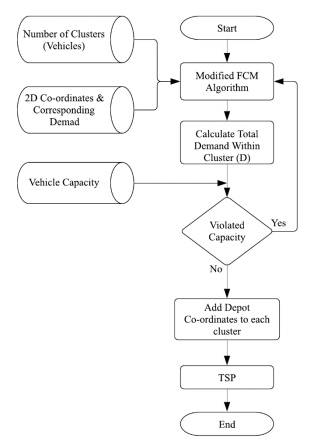
Supervised fuzzy C-means techniques to solve the capacitated vehicle routing problem
Fuzzy C-Means (FCM) clustering technique is among the most effective partitional clustering algorithms available in the literature. The Capacitated Vehicle Routing Problem (CVRP) is an important industrial logistics and managerial NP-hard problem. Cluster-First Route-Second Method (CFRS) is one of the efficient techniques used to solve CVRP. In CFRS technique, customers are first divided into clusters in the first phase, then each cluster is solved independently as a Traveling Salesman Problem (TSP) in the second phase. This research is concerned with the clustering phase of CFRS, and TSP is
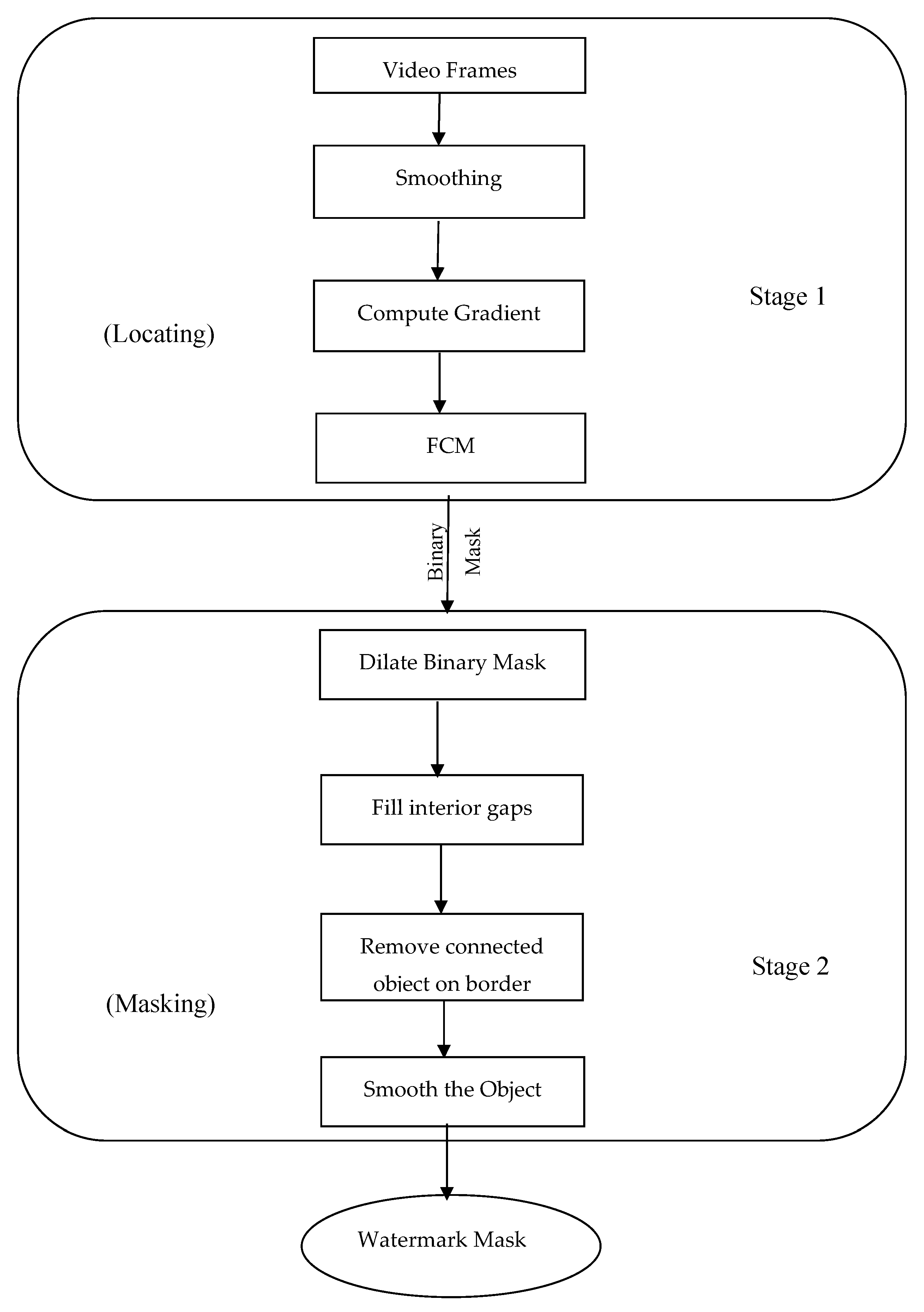
FCM-based approach for locating visible videowatermarks
The increased usage demand for digital multimedia has induced significant challenges regarding copyright protection, which is the copy control and proof of ownership. Digital watermarking serves as a solution to these kinds of problems. Among different types of digital watermarking, visible watermarking protects the copyrights effectively, since the approach not only prevents pirates but also visually proves the copyright of the broadcasted video. A visible watermark could be in any location on the frame (corner, center, diagonal, etc.). In addition, it could either completely or partially
Experimental Kinematic Modeling of 6-DOF Serial Manipulator Using Hybrid Deep Learning
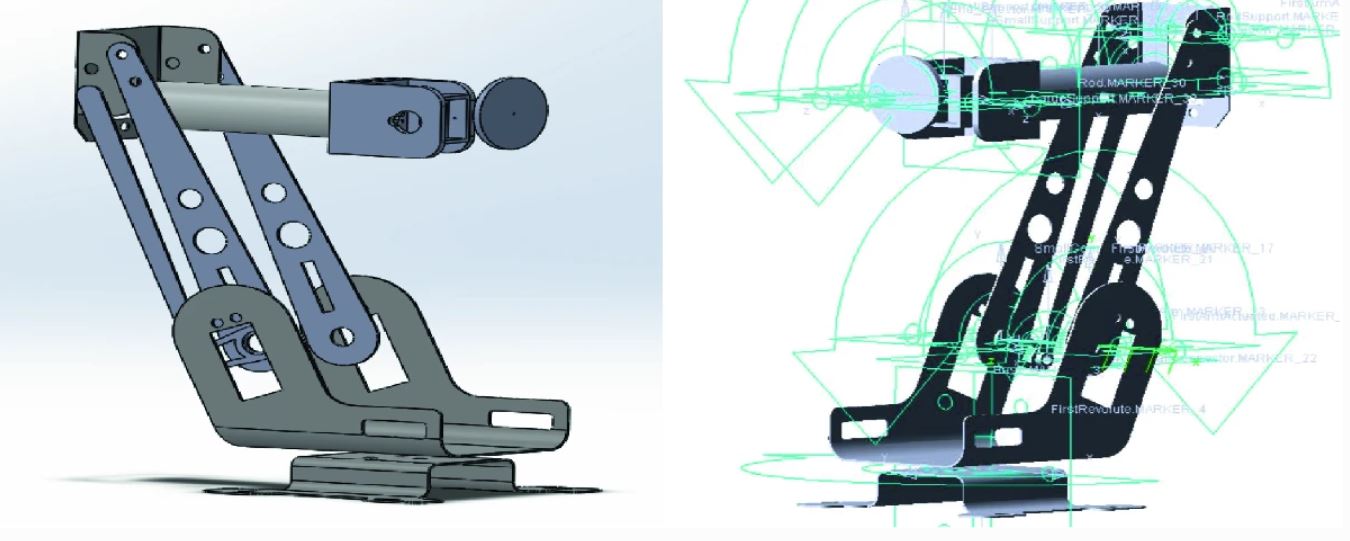
According to its significance, robotics is always an area of interest for research and further development. While robots have varying types, design and sizes, the six degrees of freedom (DOF) serial manipulator is a famous robotic arm that has a vast areas of applications, not only in industrial application, but also in other fields such as medical and exploration applications. Accordingly, control and optimization of such robotic arm is crucial and needed. In this paper, different analyses are done on the chosen design of robotic arm. Forward kinematics are calculated and validated, then